A Complete Guide to the Summer Solstice: Astronomy, Astrology, and the Medicine of summer
The summer solstice is the longest day of the year. Most people stop there.
But the solstice has carried philosophical and spiritual weight for thousands of years, across traditions that understood the turning of the sun as something more than a meteorological event. The ancient Greeks built temples aligned to it. Neoplatonists mapped the soul's journey through it. Hermetic philosophers saw in it a correspondence between the cosmic and the human. And every culture that organized its life around the wheel of the year treated this moment as a threshold.
This is a guide to what that threshold actually means, and how to work with it.
The standing still
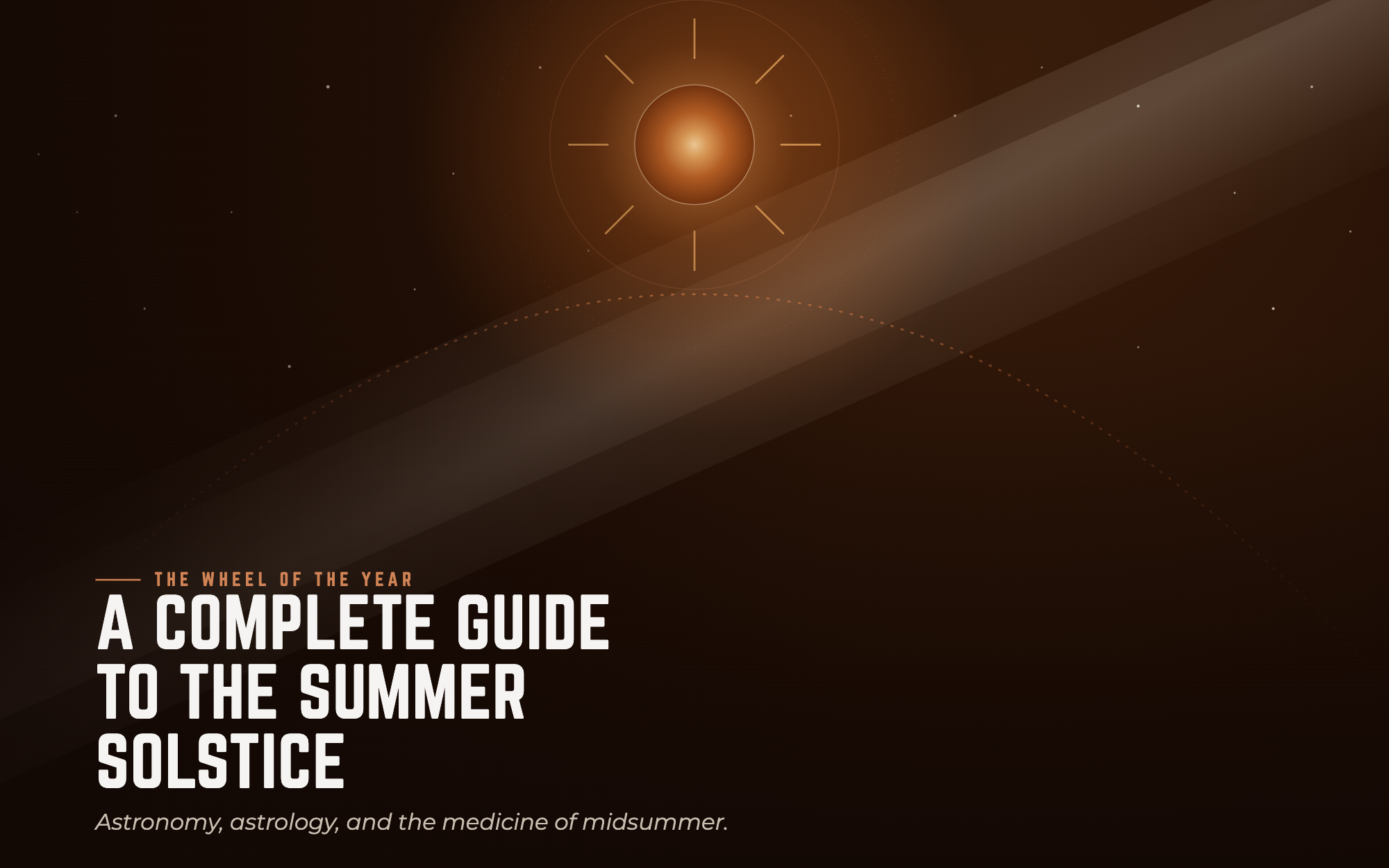
What the solstice is, astronomically
The word comes from the Latin sol sistere: the sun stands still.
For a few days around June 20–21 in the Northern Hemisphere, the sun appears to pause at its highest declination before beginning its descent. Day length peaks. The sun rises at its northernmost point on the horizon and sets at its southernmost. At noon it hangs higher in the sky than at any other time of year.
This moment marks the Sun's ingress into Cancer, beginning what traditional astrologers call the summer quadrant of the zodiac.
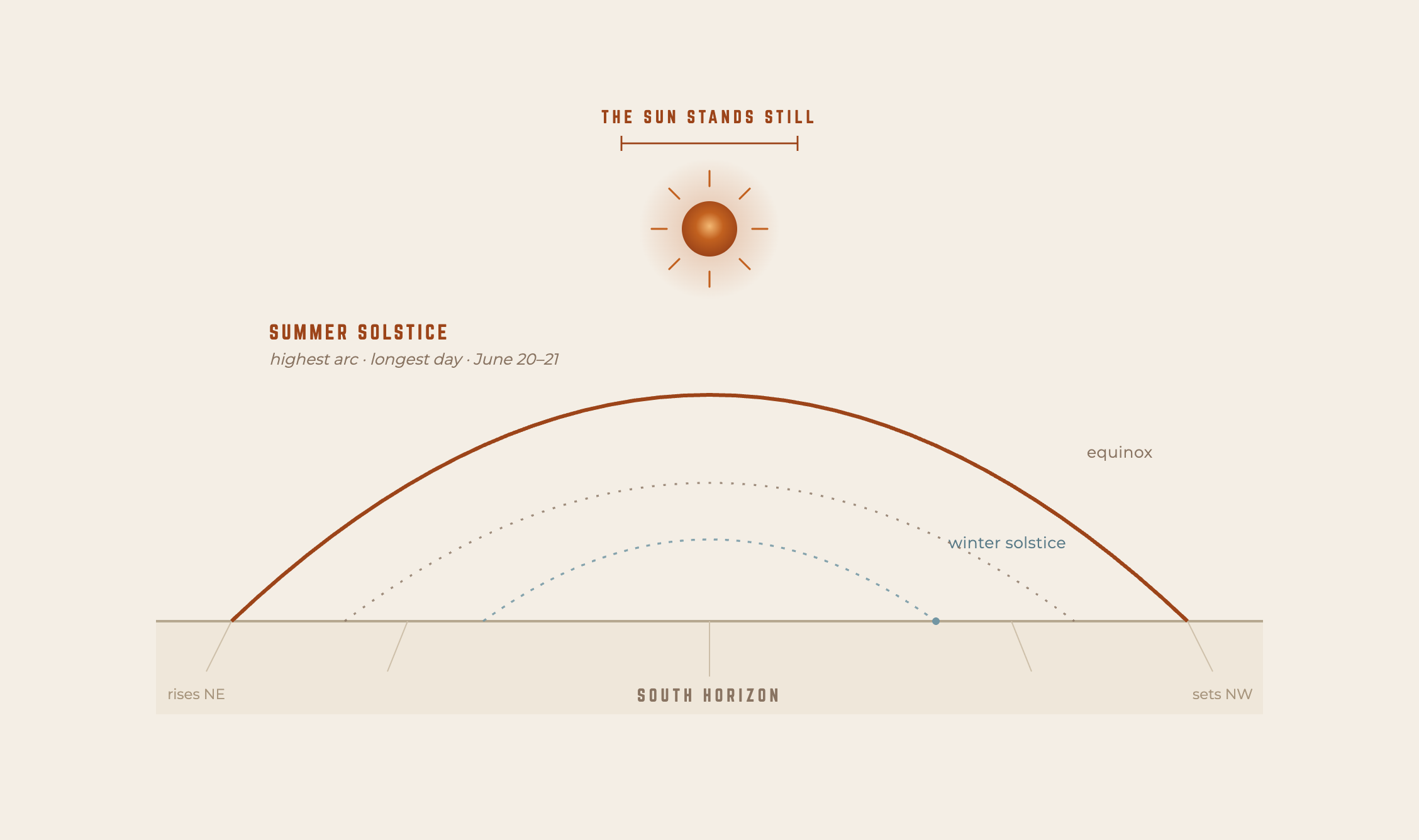
The sun's path · figure 1 At the solstice the noon sun climbs to its highest arc of the year and seems to hang there for several days before its slow return. Sol sistere: the sun stands still.
In Hellenistic astrology, the zodiac divides into two halves governed by day and night. From the winter solstice through the summer solstice, the Sun climbs: days lengthen, its power builds. This is the diurnal half of the year. After the summer solstice, the Sun begins its descent. Days shorten. We enter the nocturnal half.
The solstice is not a celebration of the sun's power. It is the moment that power peaks and immediately begins to wane.
This matters because traditional astrology understood the solstices as thresholds of sect. A day chart, one with the Sun above the horizon at birth, carries a solar quality: outward, visible, active. The nocturnal half of the year holds a different quality, more interior, more receptive, more concerned with what cannot be seen.
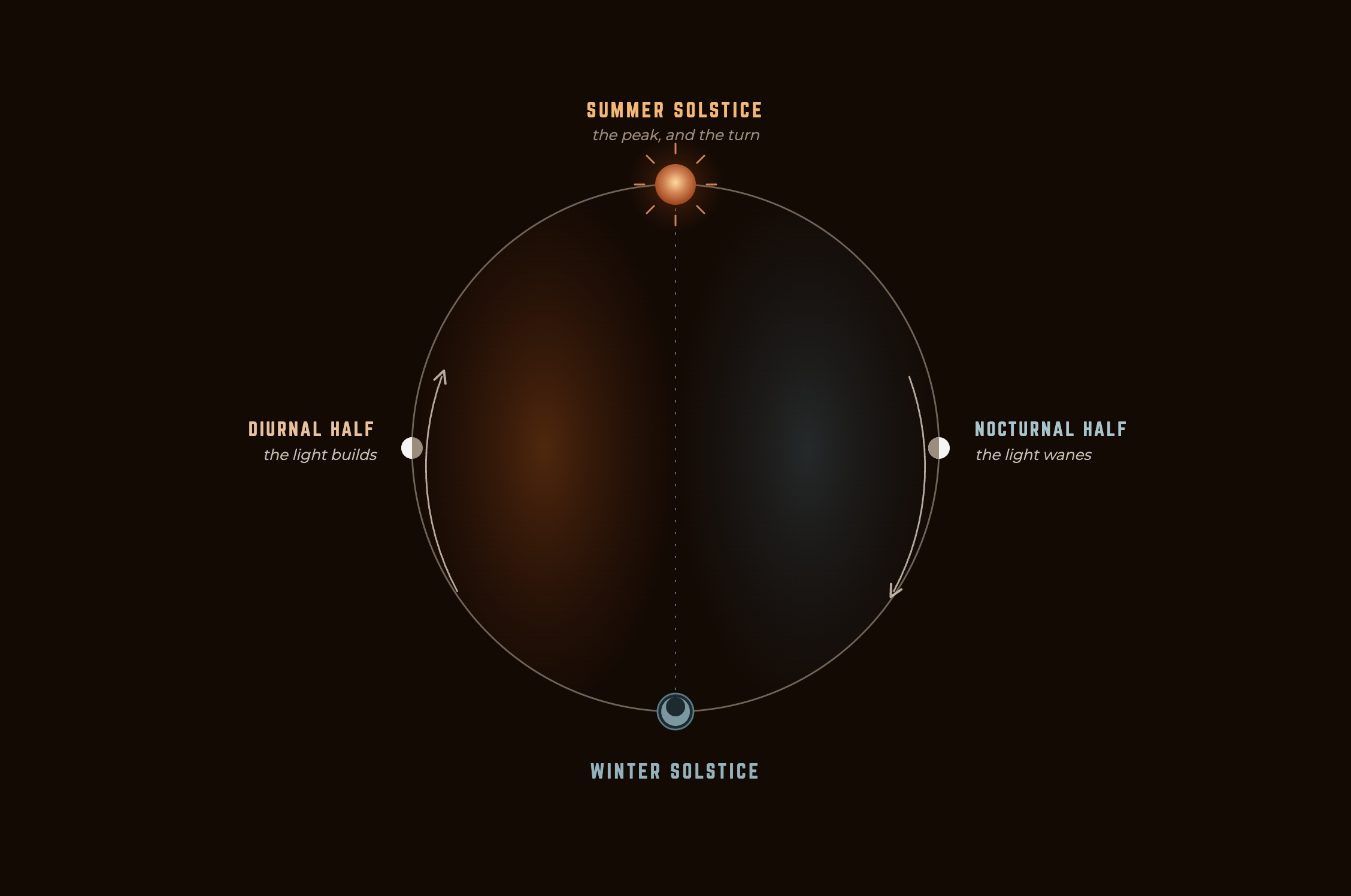
The two seasons of light · figure 2 The year crosses from its diurnal half, when light builds toward the summer solstice, into its nocturnal half, when light wanes toward winter. The solstice is the hinge.
At the summer solstice, the year crosses from one sect to the other. The Sun enters Cancer, a sign ruled by the Moon. The most diurnal moment of the year hands sovereignty to the most nocturnal planet.
In practical terms: the summer solstice marks the moment the year turns toward depth. Growth above ground is at its height. Everything that happens from here moves toward root.
The Gate of Cancer: souls descending into matter
The most striking cosmological use of the summer solstice comes from the Neoplatonist tradition, specifically through Porphyry's On the Cave of the Nymphs and Macrobius' Commentary on the Dream of Scipio.
Both writers describe the Milky Way as intersecting the zodiac at two points: Cancer and Capricorn. These intersections were called the Gates of the Sun. Cancer was the Gate of Men. Capricorn was the Gate of the Gods.
Through Cancer, souls descended from the fixed stars into matter. Through Capricorn, they returned.
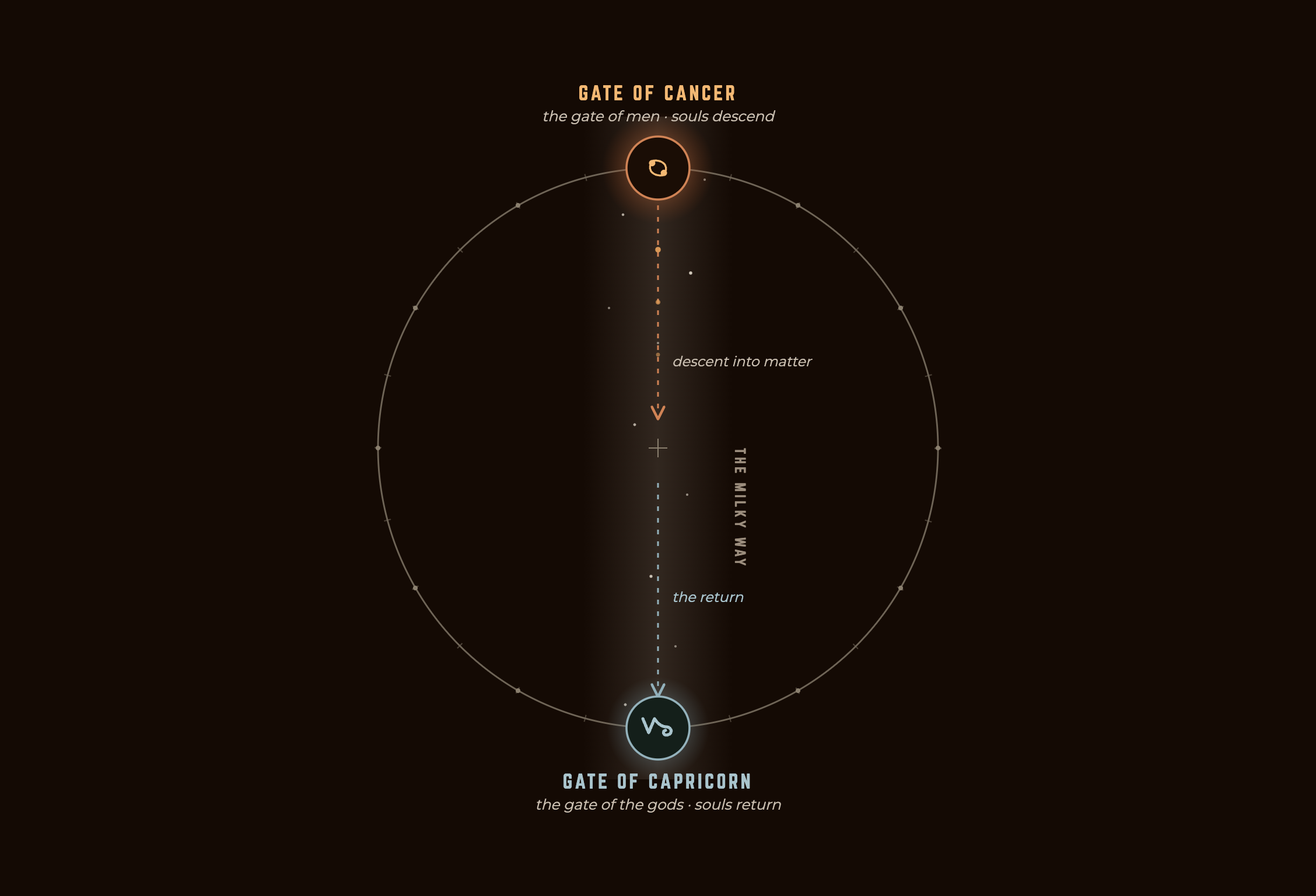
The gates of the sun · figure 3 Where the Milky Way crosses the zodiac, the ancients marked two doors. Cancer, the Gate of Men, where souls descend into birth. Capricorn, the Gate of the Gods, where they return.
The summer solstice, then, was not a moment of triumph. It was a moment of incarnation, the point at which consciousness chooses to enter the world of form. The soul, drifting in the luminous fields of the fixed stars, passes through Cancer and begins its descent through the planetary spheres. At each sphere it takes on another layer: from Saturn, time; from Jupiter, social form; from Mars, drive; from the Sun, vitality; from Venus, desire; from Mercury, reason; from the Moon, the body's moisture and the capacity to dream. By the time it reaches earth, the soul is fully clothed in the material world.
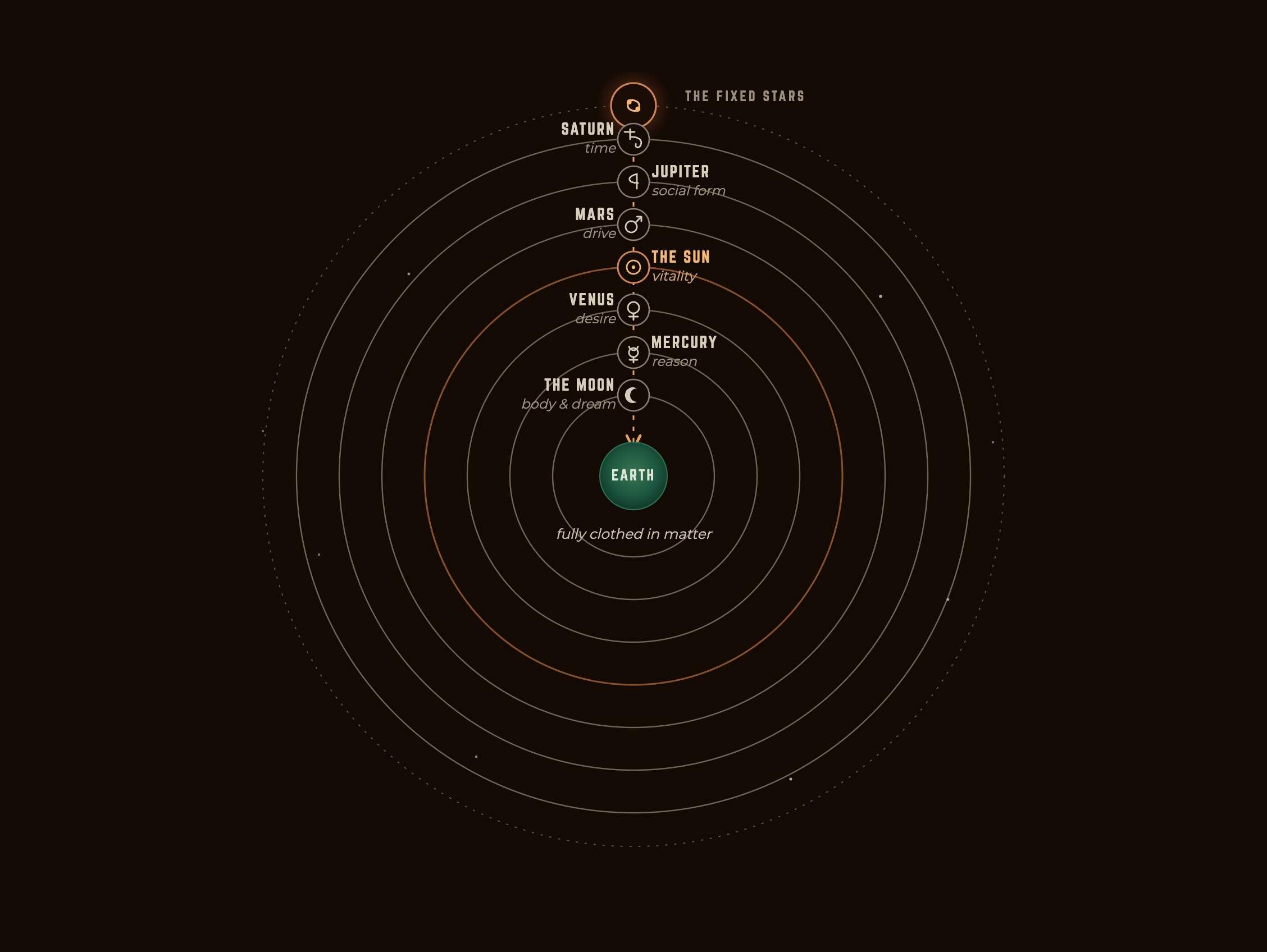
The descent of the soul · figure 4 Passing through the Gate of Cancer, the soul falls inward through the seven planetary spheres, gathering a garment at each, until it is fully clothed in matter at the center: earth, the body, this life.
This cosmology appears in Plato's Timaeus, in Cicero's Dream of Scipio, in Macrobius, in Porphyry, and in the Mithras mysteries that ran parallel to early Neoplatonism. It is not a fringe idea. It was, for several centuries, the standard philosophical account of how consciousness comes into embodied life.
The summer solstice was the hinge of that process
The Hermetic correspondence
Hermetic philosophy, rooted in the same Hellenistic-Egyptian intellectual environment as Neoplatonism, adds another layer.
The Corpus Hermeticum, attributed to Hermes Trismegistus, describes the Sun as the visible Logos, the divine intelligence made manifest in the material world. The Hermetic axiom “as above, so below” was not meant as a motivational phrase. It described an actual structural correspondence between the macrocosm and the human body: the sun in the heavens corresponds to the heart, the center of living intelligence.
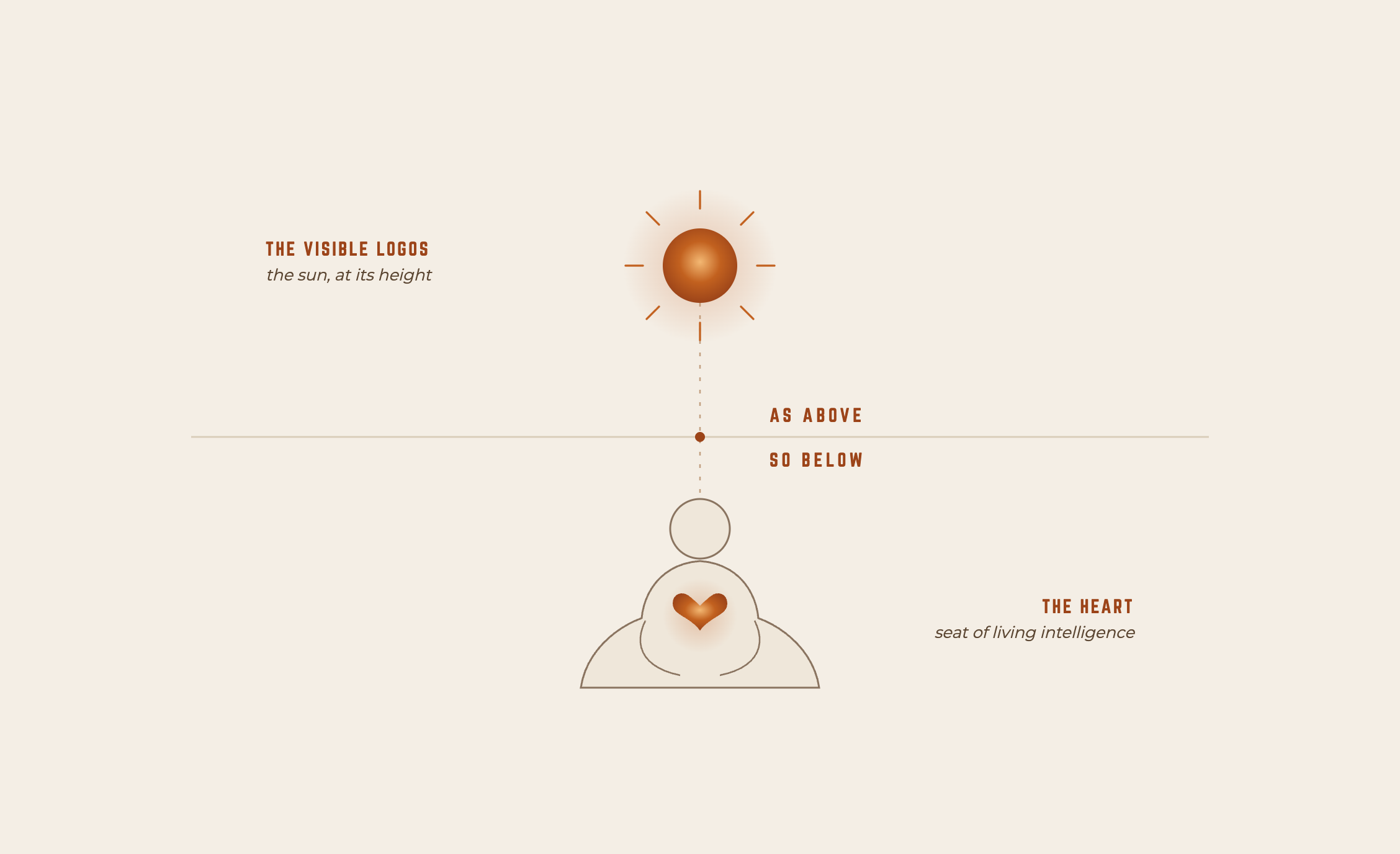
As above, so below · figure 5 The Hermetic correspondence: the sun at the center of the heavens answers to the heart at the center of the body. The outer light peaks at the very moment the inner work begins.
At the summer solstice, the visible Logos reaches its height. The correspondence is: the light outside reaches its peak at the same moment the inner work of incarnation begins. The soul has descended into the Gate of Cancer. It is fully present in matter. The outer light peaks. The inner journey begins.
This is why virtually every mystery tradition that touched Hellenistic thought, from the Eleusinian Mysteries to the Mithras cult to Hermeticism, treated the summer solstice as a moment of initiation rather than simple celebration. You are most fully human here. Most fully embodied. Most fully inside the thing you came here to experience.
The question is not “how do I celebrate the light?”
The medicine of the season
Every point on the wheel of the year carries teaching specific to that moment. The summer solstice carries several.
The paradox of the peak
You reach the longest day, and the year turns. There is no holding the peak. The solstice teaches that fullness and turning are the same event. This is not a tragedy. It is the structure of all living cycles. The willingness to be at the peak without grasping for it is the solstice's central lesson.
Full presence in matter
The Gate of Cancer is the threshold of incarnation. To pass through it consciously, even symbolically, means choosing to be here, in this body, in this life, without one foot already on the way out. Many people live at the edge of their own lives, managing rather than inhabiting. The solstice asks for full contact.
The turn inward
As the Sun enters Cancer and the year crosses into its nocturnal half, what was outward-facing becomes inward-facing. The visible work of spring, the planting and planning and external building, now asks to be tended from the inside. What are you nurturing? What needs protection to grow?
The question of light and source
The Hermetic correspondence between the outer sun and the inner heart points to a simple practice: where is your attention aimed? If the sun is at its height and you feel nothing moving in you, that is information. If it moves something, follow that.
How to work with the solstice
You do not need a ritual to work with the solstice. You need attention.
Where the solstice sits on the wheel
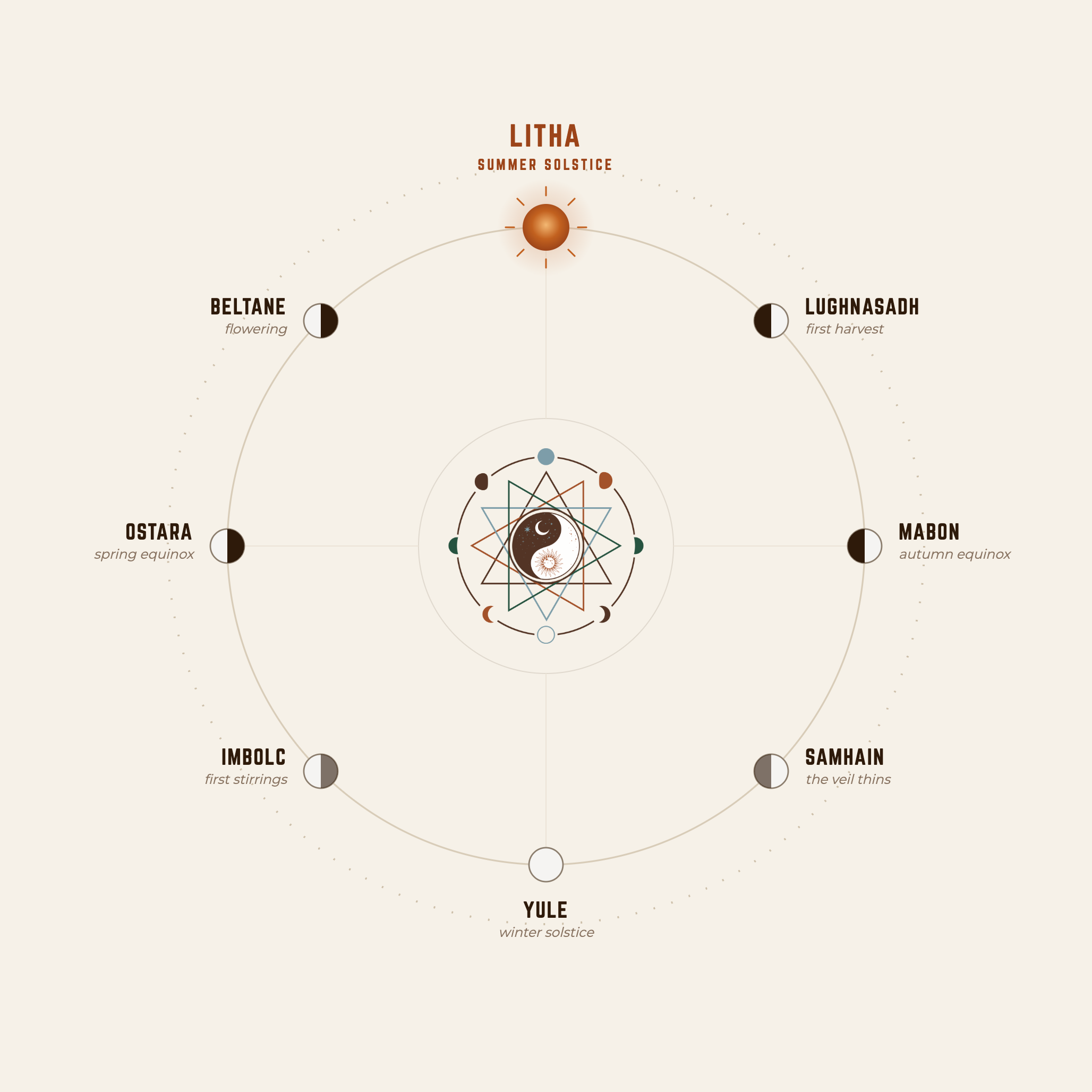
The wheel of the year · figure 6 Litha, the summer solstice, stands at the crown of the wheel. The longest day, and the first step of the long return toward dark.
Summary
The summer solstice is June 20–21 each year. The Sun enters Cancer, the year crosses from its diurnal half to its nocturnal half, and the longest day begins its return toward darkness.
The year has been building to this.